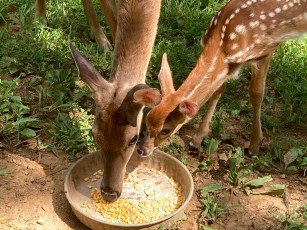
Fawns and flowers

Remember! This blog displays best if you follow the link to FrenchBroadHollow.com.

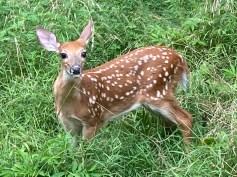
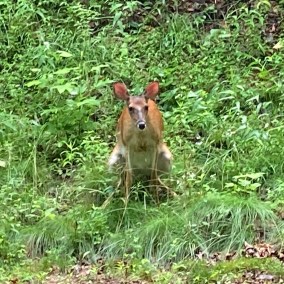
Curious fawn 7-18-20

It’s been hot (for here), and we need rain in the Hollow. As you can see in some of the river pics, it’s rained all around us; we’ve had thunder and wind, but my gauge recorded only 0.07″ of rain in the last week.

I’ve been seeing fawns more often, but I’ve also seen several does without fawns this year. Since I’m pretty sure some of them were pregnant earlier, I am guessing it was a hard spring. Not only does it seem there are fewer fawns, no one in the Hollow has seen baby turkeys this year, although usually I see them regularly when I ramble, and the hens bring them to eat in the meadow. This year I see hens and toms but no babies.

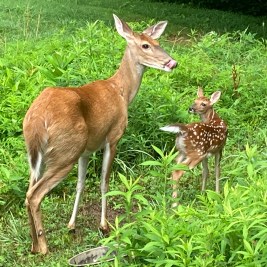
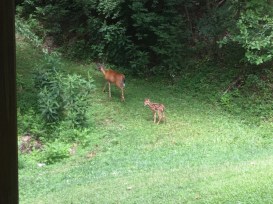
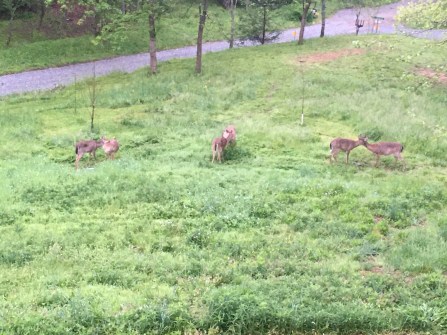
Here are some of the fawns I see. Several are of the same fawn. It must stay in the woods near the house, because the doe and fawn go through the yard often and usually show up to eat. The ones at a distance are a doe with twins.

I enjoy watching the “neighbor” fawn investigate the other critters…

including me!

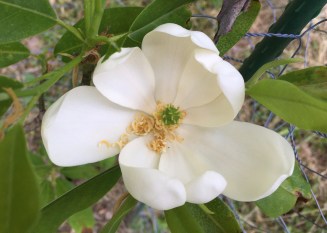
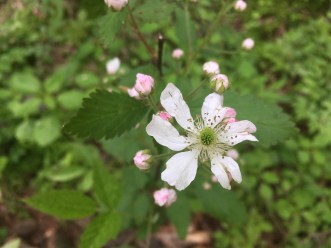
And now for the flowers in the title:

Let me remind you that I used iNaturalist.org to try to identify these flowers as best I could and welcome any corrections. Thanks. And thanks, too, for the rain that began to fall as I was writing this (a whopping 0.04″ so far!). Who knows? The next post may be about all the rain! And then there might be mushrooms!

Turtles, turtles, turtles!

fullsizeoutput_af2A few days ago (July 12) marked the third anniversary of this blog. This will be the 129th post—not quite weekly, but close!

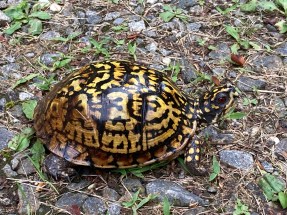
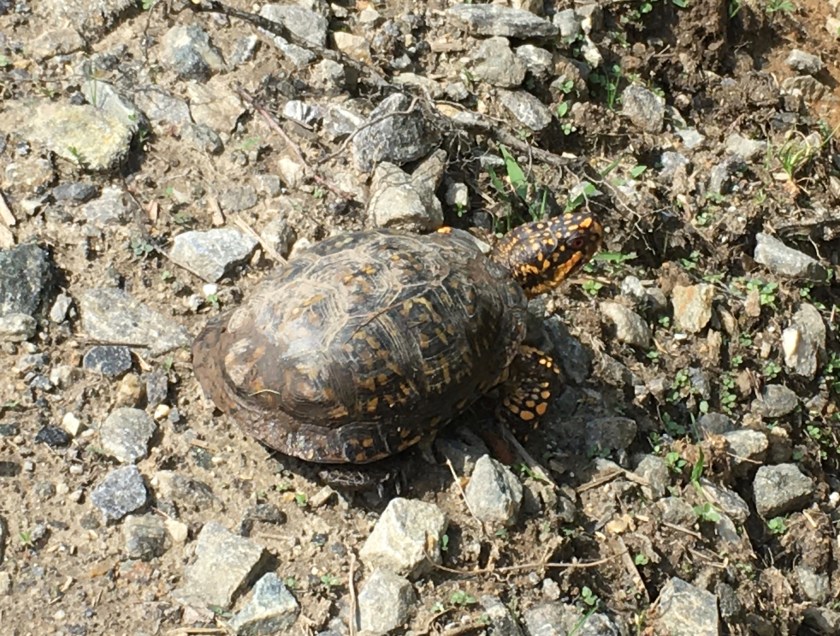
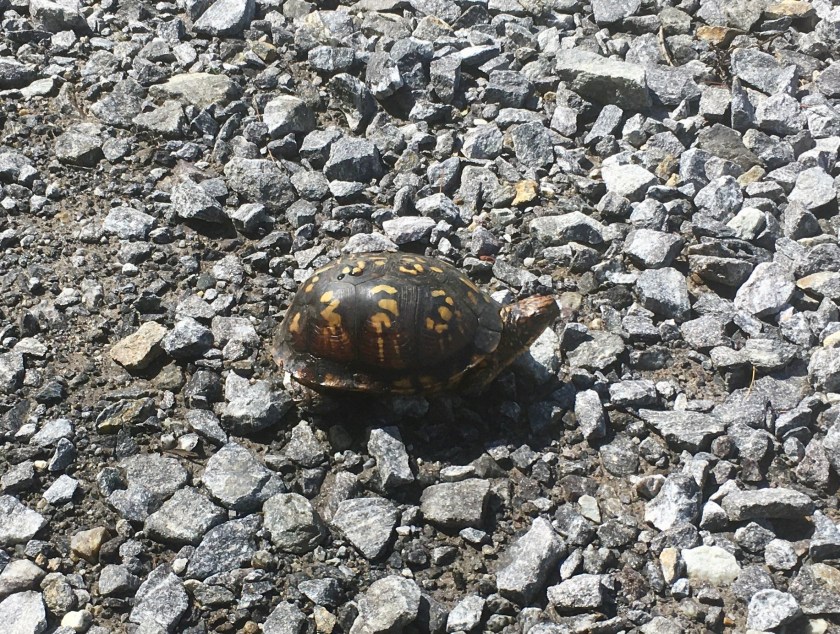
If you’ve read very many of those 128 posts, you must have realized that I am somewhat of a nature nerd. I’m interested enough in the nature around me that I actually attended a webinar recently, something I had pretty much happily sworn off after watching too many boring ones when I was still working. Fortunately, this one, Box Turtles: Disappearing Gems of the Forest, presented by the North Carolina Wildlife Federation, was interesting and educational. (You can watch it yourself here.) So, although I’ve seen some fawns (so cute!), this post will be mostly about Eastern box turtles (Terrapene carolina). Many past posts have featured turtles I see on my walks; these are some that have been near a gravel road during the past few weeks.

Box turtles are territorial, and I sometimes see the same ones on the driveway and in the yard and the meadow. (Unfortunately, I later found the empty shell of the small one in the yard and the other small one dead on its back near the road.)

I also see box turtles in the shallow, wet-weather creek that runs by the road, sometimes singly but several times lately two at a time. (I started walking a short stretch along the creek instead of the road after the webinar.) Others in the Hollow are also interested in nature, and recently my 16-year-old neighbor went for a twilight walk with a couple of friends. They reported having seen EIGHT box turtles in the creek, including four that were “sort of grouped together” (no pics of this, however). Since then, I have seen at least four in the same ~75 yard stretch of the creek several times. (Some of these photos show the same individuals on different days.)

My turtle photos have usually been of the top (carapace) and/or the head as a means of identifying individuals. One of the things I learned from the webinar is that the pastron (bottom) of each turtle is also unique. Some of them are quite beautiful!

OK, since you managed to read this far, here’s a video of one of the fawns and a turkey.

And that’s about it for today. Next time I’ll show you more deer! 🙂

Who’s watching?

IMG_2564

Who’s watching? I hope you haven’t been watching your inbox for a new post; it’s been a while. I usually prefer to be outside when the weather is nice, and there’s always something to keep me busy. Today is hot and humid, and I decided to try and get this updated.

So, who is watching? I’ve been watching for fawns and finally got a brief glimpse of one about 10 days ago. Since then, I’ve seen only a couple of does with their fawns crossing the gravel road (one pair much too close to the highway!) and one pair that passed by the house earlier today.IMG_2520

Who else is watching? Last year’s fawns—Bambi, Bro, and Lil—watch for me most mornings, often from just outside the basement door. And one morning Bambi watched me walk up to him and didn’t even bother to get up!

Tom and Tommy watch for me in the afternoons, although sometimes Tom also watches for hens to see if they will watch him.

And I watch for critters as I walk, although I know they are much more aware of me than I am of them. This year I am being watched by lots of cottontail rabbits (Sylvilagus floridanus), many more than I remember from past years.

Sometimes I’m watched by deer as I walk; Bambi and Bro recognize me.

And sometimes I watch them take care of their business. 🙂Lil squats 7-2-20

Now I,m watching the meadow to see if it’s time to feed, watching the muchachos and Moseby as they work on their relationship,IMG_2657

and watching the clock tell me that it’s feeding time! Maybe I’ll see more fawns before the next post!

Sphinx, skinks, pinks, and stinks

Sphinx: I was pleasantly surprised to see this this strange, beautiful Walnut Sphinx Moth (Amorpha juglandis) on one of my porch posts. (Click on the image to see a larger view.) According to iNaturalist, “When attacked by a bird, the caterpillar produces a high-pitched whistle by expelling air from pair of spiracles in its abdomen.” I wish I’d heard that!

Skinks: Many lizards live around my house and garden; I often see them sunning on the rock wall or the pebble-dash stucco. This Southeastern Five-lined Skink (Plestiodon inexpectatus) was on a stack of leftover decking.

Pinks: Deptford Pink (Dianthus armeria) was introduced to North America and has now naturalized. In other words, it’s another exotic, but at least it’s not very invasive. I first noticed it in the small meadow above my house several years ago, and this year I have seen it by the road in several places as I ramble.

And stinks! Really! While searching for whatever it was that I thought had died in my garden, I found this orange claw-like thing protruding from the soil—a Stinky Squid Stinkhorn Mushroom (Pseudocolus fusiformis)! Yuck! If you find one, you’ll know why it’s called a stinkhorn!

Today’s forecast called for an 80% chance of rain, but it’s been sunny most of the day. It was pleasantly warm after several cloudy days with lows in the low 50s and highs in the 60s. I’m still waiting for the rain, however, or I’ll have to water the garden tomorrow.

The Sphinx isn’t the only moth attracted to the porch light. Below are a Tulip-tree Beauty Moth (Epimecis hortaria), an Eastern Tent Caterpillar Moth (Malacosoma americana), a Locust Underwing Moth (Euparthenos nubilis), and a Large Lace-border Moth (Scopula limboundata) I saw in the meadow. (This is a good time to issue the disclaimer that I am by no means an expert on identifying most of the flora and fauna I post about. I rely on iNaturalist.org as a guide; sometimes someone with more knowledge suggests a correction, which I welcome. :-))

The most common lizard species near my place is the Eastern Fence Lizard (Sceloporus undulatus). And they seem to like it here; I watched courtship (I think) and mating one afternoon (hard to see in the pic). BTW, this little hollow must have great vibes—today I saw two butterflies mating (no pic) and last year it was turkeys!

No fawn sightings yet, although I look out several times a day. I’ll be sure to post photos as soon as I have some; I hope it’s soon!

“More of the earth, farther from heaven”

IMG_2089

In June 1854 Henry David Thoreau wrote, “It is dry, hazy June weather. We are more of the earth, farther from heaven these days.” In June 2020, it seems as though we of the earth are still farther from heaven, even as many try to make the earth a better place for all to live.

Here in the Hollow, nature continues to move along in her typical languid manner, without regard to pandemics or civil unrest. It’s been unseasonably hot and humid (for here, not like in Alabama!). We’ve had only one good rain (downpour) since the last post; walking is treacherous in places where the gravel is loose and dusty when a vehicle passes by at more than a crawl. The deer are plagued by flies and other pests; I take a handheld zapper down when I feed in the afternoons.

The three yearling deer (Bambi, his brother, and the little doe) show up regularly; I think their mothers have chased them away to care for this year’s fawns. The two young bucks stay close by and often rest in the meadow. Most of the formerly pregnant does must have fawns somewhere, and I take feed down whenever I see a now-skinny doe. I expect to see a fawn any day now.

The butterflies love the sunny days.

The Great Spangled Frittilaries really love the Purpletop Vervain (Verbena bonariensis), or tall verbena. (Oh yeah, a possible invasive that I purposely planted!)

I often see eastern cottontail rabbits (Sylvilagus floridanus) and eastern gray squirrels (Sciurus carolinensis) when I walk, although they usually see me first and run off before I can get a good photo.

I have better luck with the trail camera and capture photos many critters (some of which I would rather not have nearby). These photos are some from earlier this spring, when I had the camera set up first in the meadow and then near the salt block and creek. (For some reason, I can’t edit the captions.)

If this heat keeps up, I may post again soon!

Where did the time go? No kidding, where did it go?

Apparently time is not under quarantine and, like the river, just keeps on rolling along. I started this post almost a week ago, and I hope to post it today! Maybe I need to get to work like these ants!

If you’ve followed this blog for a while, then you know that I am partial to Eastern Box Turtles (Terrapene carolina), and this time of year they are out and about, especially after a rain. (By the way, should you see a turtle in the road, follow these steps: https://www.wildlifecenter.org/tips-helping-turtles.) Usually I am on my walk when I see one, but one morning I saw one in the meadow as I walked up after feeding the deer, and then I found a small one in my yard. (I saw the little one in the yard again today. ) I even saw one down in the creek!

Different flowers are blooming now, including the beautiful but invasive Japanese Honeysuckle (Lonicera japonica); sometimes the scent is almost cloyingly sweet as I walk. For some reason, I am particularly fond of the Narrow-leaved Blue-eyed Grass (Sisyrinchium angustifolium); I’m happy to be seeing more of it this year along the roads and in my meadow.

I haven’t seen any fawns yet, but the young deer, especially Bambi,his brother, and the little doe come pretty regularly. They are often bedded down in the meadow—or in the yard!—when I get up.

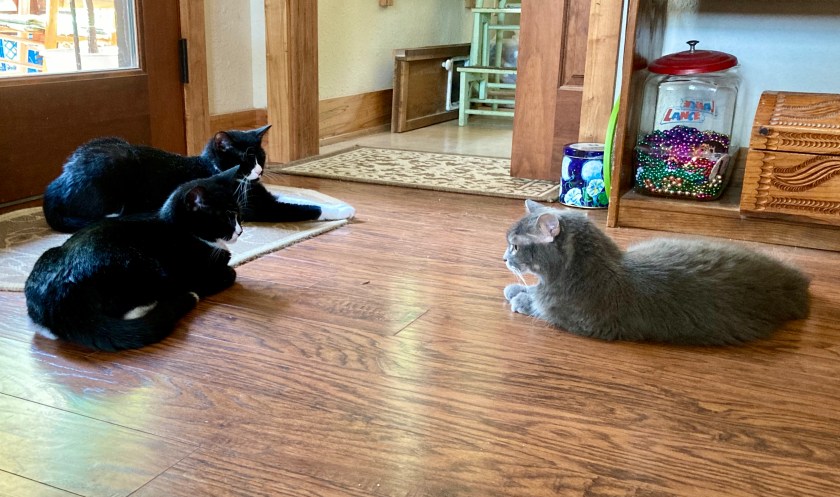
And just like that, time flew by again. I already took food down to the deer and checked on the little turtle; now it’s time to feed the cats. (Remember these muchachos? And, yes, there are cat toys all over my house. :-))

Maybe I’ll be able to catch up on time and post again before too long. Maybe…

Rainy day rest

Sweetbay Magnolia Magnolia virginiana – Version 2
https://www.inaturalist.org/taxa/127906-Magnolia-virginiana

It’s raining today, and I decided to take a day off from walking, although I almost kept going when I went down for the mail. I’m glad I didn’t since it since it started to rain harder as soon as I got back to the house.

I haven’t seen the deer as regularly lately. Sometimes I see them when I first get up and look out my bedroom window, but they’re usually gone by the time I get downstairs, and I never know if or when they will show up during the day. I’m sure some of the does have fawns hidden somewhere, and last year’s are now on their own. I looked out just as I began writing this and saw Bambi eating in a recently cleared area. Of course, I took corn and an apple and went down to the meadow, where he was joined by his brother, last year’s doe fawn, Lil Girl, and a couple of pregnant does.

The cleared area had been overrun with invasive multiflora rose (Rosa multiflora) and oriental bittersweet (Celastrus orbiculatus) until recently.  I was fortunate to hire someone who was knowledgeable about invasive plants to make a (small) dent in the many invasive plant species near my house. (He is a Peace Corps Response Volunteer who had been evacuated due to COVID-19.) He also got rid of some Chinese privet, Japanese honeysuckle, bush (Amur) honeysuckle, amd a few other exotic shrubs and small trees. Invasive plant species are all over the Hollow, and, as much as I don’t like them, I must admit that some are beautiful.

Lovely as the exotics are, I prefer the natives. I see them on my rambles and have planted some near my house.

The turtles also have homes on the Hollow, and I feel lucky every time I meet one as I ramble.Turtle on Mtn Hollow 4-9-20Turtle on Mtn Hollow 4-26-20IMG_1872Turtle on Mtn Hollow 5-17-20

Meanwhile, the birds continue to sing,

Tom continues to strut,

and it’s time for me to do chores.

Blackberry winter’s a-comin’

IMG_1882

It’s been a while since my last post. I’m happy to say that I can’t blame the delay on the pandemic (although I seem to be meeting more neighbors on the road as I ramble). It’s simply that it’s hard to work on this blog in the springtime, when each day brings more leaves on the trees, new blooms, and other surprises. But after a record high of 84° a few days ago, we’re about to have blackberry winter this weekend with a forecast of lows in the 30s and a frost advisory. That may keep me inside! 🙂

With the arrival of spring the sights and sounds of birds have changed, too. The male ruby-throated hummingbirds duel each other at the feeders, and the rose-breasted grosbeaks have made their all-too-brief appearance. The indigo buntings are back at the feeders, and the Canada geese that live by the river lead their goslings. (You can see the geese in some of the river photos on each post.)

The wild turkeys are strutting,

and the wood thrushes are singing their melodious songs.

The butterflies are arriving, too, including monarchs on their northward migration. We have lots of milkweed in the Hollow; it’s not blooming, but at least there are plants available for monarch egg-laying.

The deer were busy grooming each other this morning after a brief rain shower, and they’ll show up any minute now for dinner.IMG_1887

I’ll try for a longer post next time, probably during the upcoming blackberry winter!

April showers

Remember! This blog displays best if you follow the link to FrenchBroadHollow.com.

If April showers bring May flowers, then next month should be spectacular! So far this month we’ve received almost 17″ of rain (which is much less than those of you in other parts of the Southeast).

As elsewhere, the rain often came in downpours with lots of wind. Overnight Easter Sunday into Monday we had 4.5″ of rain and winds over 40 mph, resulting in several minor mudslides and deepening the gullies already present in the road. Fortunately, a retired neighbor cleared the blocked ditch. The wind blew a large tree down across the new neighbors’ freshly laid asphalt, but they were able to get the road cleared.

The upside is that there are now lots of sticks. Why? Because the new neighbors have two LARGE dogs who want anyone who walks by to give them a stick, and now we have an ample supply!Ludo & Hank 4-16-20

The deer haven’t been coming as regularly, and one day I never saw them at all (although they may have come when I wasn’t looking). Sometimes, however, they wait for me.

They’re not waiting now, but the cats are. I know this is a short post, but it looks like we may have more rainy days ahead, which makes it easier to stay inside. Keep safe!

Changes

Remember! This blog displays best in a browser, not in email or Facebook.

fullsizeoutput_9de

Spring is a busy time, with lots of chores that need to be addressed—some new and some (many) left over from the winter, or even the fall. 🙂 But spring is also a time when things around us change almost daily.

Birds that visit for the winter are heading north, and others are returning after migrating south in the fall. More and different types of butterflies and other insects are around. I think I saw a monarch butterfly a few days ago, although it was gone before I could tell if it was a monarch or a viceroy.  However, it must have been a monarch since, according to journeynorth.org, adult viceroys don’t emerge until about 15 days after willow or poplar leaves have emerged, and those trees are still pretty barren here in the Hollow.

Different wildflowers are emerging, some trees are now in full bloom while others are dropping blossoms and leafing out. Below are Blackhaw (Viburnum prunifolium), Flowering Dogwood (Cornus florida), Star chickweed (Stellaria pubera), Eastern redbud (Cercis canadensis), Philadelphia Fleabane (Erigeron philadelphicus), American Alumroot (Heuchera americana), Coral Honeysuckle (Lonicera sempervirens), Southern Crabapple (Malus angustifolia), and Chickasaw Plum (Prunus angustifolia).

Reptiles have begun to emerge from hibernation, including this rat snake that makes the rounds near my house. (It’s on the wall!)

The turkeys feel spring, too, and the toms seem to gobble most of the day. Evidently they are having some success, as I also see hens in the meadow several times a day.

The deer are changing to their summer coats, and the pregnant does are getting bigger. Bambi’s taste for apples hasn’t changed!

Remember Cisco and Pancho, the new muchachos in my house? They’re changing, too. They seem to be interested in housework and also enjoy birdwatching, but they’re still just kittens (large ones!) and get tuckered out.

https://youtu.be/IHK0nhDHlFI

Many of the changes we’re experiencing in the world these days are sad and scary. It’s comforting to realize that some changes are beautiful, interesting, and/or amusing. My hope is that the changes you experience bring you comfort, combined with laughter and love.